The EU Digital Product Passport: What Every Textile Business Needs to Prepare For
The DPP isn't a distant regulatory concept. The data requirements it creates are something textile businesses, recyclers, and brands should be building towards now, not after the deadline lands.
The EU Digital Product Passport (DPP) is one of those regulations that gets mentioned a lot in sustainability discussions but still feels abstract for many businesses. That's starting to change. As implementation timelines firm up and sector-specific requirements get published, the question is shifting from "what is this?" to "what do we actually need to do?"
This post is an attempt to give textile and recycling businesses a practical picture of what the DPP means for them, and why the most useful thing you can do right now is start building the data infrastructure rather than waiting for final guidance.
How Scan Data Feeds the Digital Product Passport
What the Digital Product Passport actually is
The DPP is a core element of the EU's Ecodesign for Sustainable Products Regulation (ESPR), which was formally adopted in 2024. The idea is simple: every product placed on the EU market should carry a digital record, accessible via a QR code or similar mechanism, that contains information about its composition, origin, repairability, and end-of-life instructions.
For textiles, this means a garment or fabric product should carry information that tells anyone who needs it, a consumer, a sorter, a recycler, a regulator, what the item is made of, how it was produced, and what to do with it at end of life.
The DPP doesn't just require that this information exists somewhere in a supply chain database. It requires that it's accessible and machine-readable at the product level, which means it has to be embedded in the product's identity from the point of manufacture.
Why fibre composition data is at the centre of this
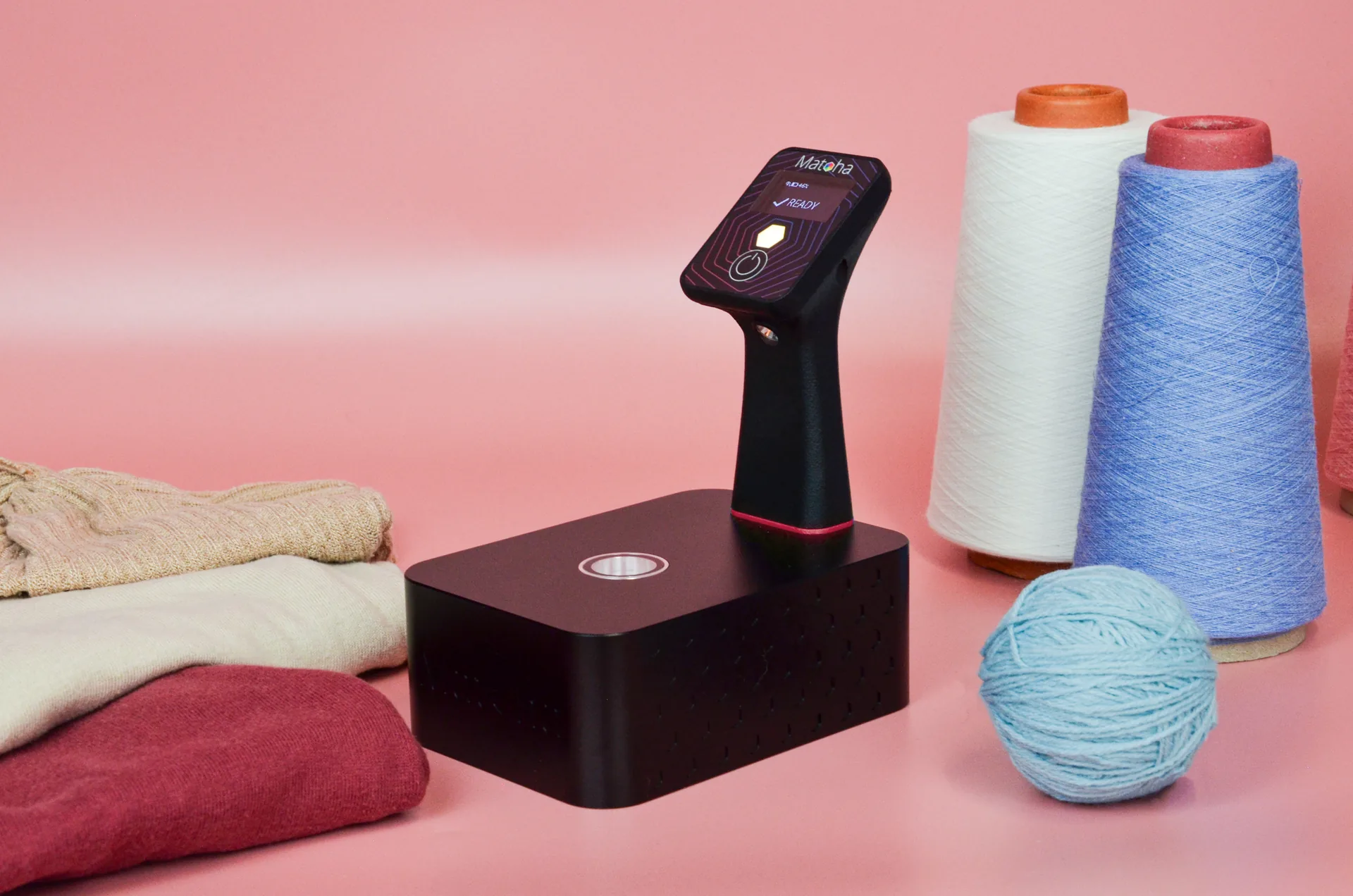
FabriTell: designed for high-volume textile scanning in warehouse and QC settings.
For textile recycling, the most operationally relevant DPP requirement is accurate fibre composition data. The downstream value of a recovered garment or fabric depends heavily on what it's made of. A pile of declared-cotton that contains significant polyester is worth considerably less to a recycler than clean cotton. A garment declared as 100% nylon that turns out to be a nylon-PP blend creates problems for chemical recycling processes.
Under the DPP framework, that composition data needs to be reliable, not just a label claim. This creates a need for verification at multiple points in the value chain: at manufacture, at import, and increasingly at the point of sorting and recovery.
Operations that already have an independent, documented fibre identification process are ahead of those relying entirely on care label declarations. A scan-level NIR record, showing what the device identified, when, and by whom, is the kind of evidence that makes composition data defensible.
What this means for recyclers and sorters specifically
Recyclers and sorters sit at an interesting position in the DPP ecosystem. They're the downstream end of the textile value chain, receiving materials whose DPP credentials may or may not be complete or accurate.
The commercial reality is that buyers of recovered material are increasingly asking for composition documentation alongside bales. This is already happening in markets where verify material compositions matter for premium pricing, and it will intensify as DPP-linked traceability becomes a market norm rather than a voluntary extra.
Sorting operations that can provide scan-level composition records, timestamped, by item, by operator, exportable in standard formats, will be better positioned with buyers than those offering only visual-grade estimates. That gap is likely to widen over the next two to three years.
The data infrastructure question
One of the practical challenges with DPP compliance is that it requires data systems that many businesses don't currently have. A garment's composition data needs to travel with it through the value chain, not sit in a spreadsheet on a sorting manager's laptop.
This is where cloud-connected identification tools become more than just a productivity gain. If every NIR scan creates a structured, cloud-stored record, accessible via API, exportable to buyer or regulatory systems, you're building the data layer that DPP-adjacent compliance will need.
Operations investing in connected identification tools now are, in a very real sense, investing in their DPP readiness, even before the DPP formally applies to their product category.
What to do now
The DPP implementation timeline for textiles is still evolving, and sector-specific requirements are being developed through delegated acts. But there are practical steps worth taking now:
Understand your data gaps. What composition information do you actually have, and how verifiable is it? If your only source is the care label, that's a gap worth acknowledging.
Audit your incoming material. If you receive material with composition claims you can't verify, introducing an independent check at goods-in is a straightforward starting point.
Think about data outputs, not just identification. An NIR device that identifies materials but stores nothing is only half the answer. Structured, exportable data is the useful output.
Watch the delegated acts. Sector-specific DPP requirements will be published as separate delegated acts. The textiles sector is expected to be in an early wave. Staying close to European recycling associations is the most reliable way to track timing.
Matoha's Cloud platform logs every scan with timestamp, operator, result, and GPS location, creating the kind of auditable composition record that downstream buyers and compliance frameworks increasingly need.
The DPP isn't asking the textile industry to do something fundamentally impossible. It's asking for data that the industry already needs to be more efficient and more valuable. The businesses that will find this transition easiest are those building the data habit now, rather than scrambling to retrofit it when the deadline arrives.
Why choose a subscription over a one-off purchase?
+
A subscription spreads the cost into predictable monthly payments, includes software updates, and can be easier to justify as an operating expense rather than a capital purchase. A one-off purchase gives you full ownership with no ongoing fees. Both options include access to the Matoha app and Cloud dashboard. Compare options →
How long is the contract for subscriptions?
+
Subscription terms vary by plan. Please contact us for current contract lengths and flexible options — we can often accommodate rolling monthly or annual arrangements depending on your needs.
What is the cancellation policy?
+
One-off purchases come with a 21-day money-back guarantee — if the device doesn't work for your materials, return it for a full refund. For subscription plans, cancellation terms are outlined in your agreement. Get in touch if you have any questions.
How long does delivery take?
+
FabriTell, PlasTell and CarpeTell handheld devices ship within approximately 60 days of order. The S-Bench system has a longer lead time due to custom configuration — contact us for current availability. We ship worldwide.
Can I try before I buy?
+
Yes — we offer a live demonstration where we scan samples you send in advance, so you can see results on your own materials before committing. All devices also come with a 21-day money-back guarantee. Book a demo →
Do the devices work without an internet connection?
+
Yes — all Matoha devices identify materials fully offline. The AI runs on-board, not in the cloud. Wi-Fi is only used for syncing scan data to Matoha Cloud and receiving firmware updates, both of which are optional.