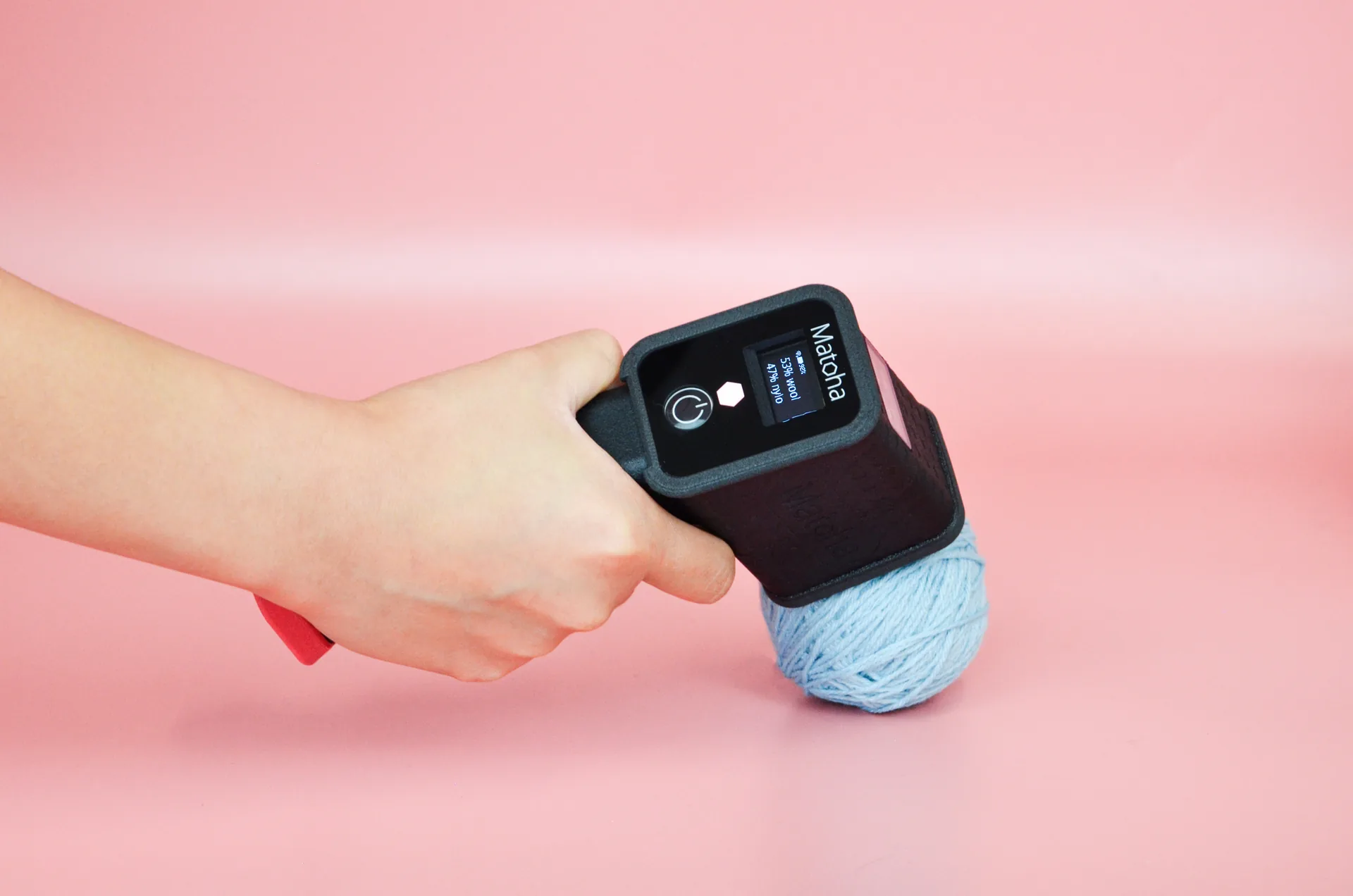
If you work in textile recycling, plastic sorting, or any material recovery operation, you've probably heard the term "NIR" used more often in the past couple of years. Some companies are deploying it at scale. Others are still trying to understand what it actually is and whether it belongs in their operation.
This is a straightforward guide to near-infrared spectroscopy, what it does, how it works at a practical level, and why sorting operations across 60+ countries are finding it useful.
The Electromagnetic Spectrum, Where NIR Sits
The basic idea: light tells you what something is made of
FabriTell puts NIR spectroscopy into a 340g handheld, the same technology as lab instruments.
Near-infrared spectroscopy works by shining a beam of near-infrared light onto a material and measuring how that material absorbs different wavelengths. Every polymer, fibre, and blend absorbs NIR light in a characteristic pattern, a kind of molecular fingerprint. The instrument reads that fingerprint and matches it to a reference library to give you a material identification.
The process takes less than a second in most handheld instruments. The operator doesn't need to perform any preparation, no dissolving, burning, or chemical treatment. You scan, you get a result, you move on.
NIR spectroscopy has been used in pharmaceutical quality control and food testing for decades. What's changed in recent years is the cost and form factor, instruments that once required a laboratory and a trained technician now fit in one hand and cost a fraction of the price.
How NIR Identification Works, In Four Steps
What NIR can identify
The range of materials identifiable by NIR depends on the instrument and the reference library it carries. A well-designed textile NIR device can typically distinguish between:
Pure fibres: cotton, polyester, nylon, wool, silk, viscose, linen, acrylic, and others
Common blends: polyester-cotton, nylon-elastane, cotton-viscose, and more
Weave types and fabric constructions in many cases
Plastic-focused NIR instruments can identify polymer types including PE, PP, PET, PVC, PS, ABS, nylon, and many others, including black and dark-coloured plastics that traditional optical sorting cannot read.
Carpet NIR instruments can separate polypropylene from nylon, and in some cases distinguish PA6 from PA6.6, two polymers that look identical to the human eye but have meaningfully different recycling values.
Why this matters for sorting operations
Manual sorting relies on human pattern recognition, texture, weight, label reading, and experience. It can work well for straightforward streams, but it has real limits. Labels get removed. Blends look like pure fibres. Black plastic is essentially opaque to colour-based methods. And skilled sorters are expensive to train, retain, and scale.
NIR doesn't replace the judgement of experienced sorters, but it does give every operator, regardless of their experience level, a consistent, objective data point for every item they handle. Operations that have introduced NIR at the point of sorting tend to report fewer misdirections, faster throughput on ambiguous items, and more defensible records for downstream buyers and compliance purposes.
The compliance angle
This is increasingly relevant. The EU's Digital Product Passport regulation and Extended Producer Responsibility frameworks are creating data requirements that manual sorting simply cannot satisfy. Buyers of recovered materials are increasingly asking for documented fibre or polymer composition alongside bales. NIR scanning creates a scan-level record, time-stamped, operator-attributed, exportable, that paper-based systems cannot.
Operations that are building NIR into their sorting workflow now are effectively building the data infrastructure that compliance will require. Those waiting for regulations to land first will face a harder retrofit.
Practical considerations when evaluating NIR
Not all NIR instruments are designed for industrial sorting environments. When evaluating options, it's worth considering:
Speed: Sub-second identification is achievable and important for throughput. Instruments that require multiple scans per item or longer acquisition times will create bottlenecks.
Library depth: The reference library determines what the instrument can identify. A library built on textiles won't serve a plastics operation, and vice versa.
Durability: Sorting floors are dusty, humid, and rough. IP ratings and build quality matter for long-term reliability.
Data output: Identification alone has limited value if the data isn't recorded and exportable. Cloud connectivity and structured data output increasingly separate capable systems from basic ones.
Where NIR fits in the broader sorting workflow
NIR identification works best as one layer in a multi-step process, not a wholesale replacement of existing systems. Most operations introduce handheld NIR at specific decision points: incoming goods verification, high-value material separation, blend checking, or quality control before baling. Bench-mounted systems can integrate into sorting stations for continuous, hands-free identification of each item.
The technology is mature. The unit economics are increasingly favourable. And the regulatory environment is creating data requirements that make a documented identification process more valuable every year.
If you're still relying entirely on visual inspection and experience, it's worth at least understanding what NIR can and can't do in your specific material stream, before your buyers or your regulators ask the question first.
Matoha makes NIR identification devices for textiles (FabriTell), plastics (PlasTell), and carpet (CarpeTell). If you'd like to understand whether NIR is a fit for your operation, get in touch, we're happy to talk through your material stream before any commitment.
Why choose a subscription over a one-off purchase?
+
A subscription spreads the cost into predictable monthly payments, includes software updates, and can be easier to justify as an operating expense rather than a capital purchase. A one-off purchase gives you full ownership with no ongoing fees. Both options include access to the Matoha app and Cloud dashboard. Compare options →
How long is the contract for subscriptions?
+
Subscription terms vary by plan. Please contact us for current contract lengths and flexible options — we can often accommodate rolling monthly or annual arrangements depending on your needs.
What is the cancellation policy?
+
One-off purchases come with a 21-day money-back guarantee — if the device doesn't work for your materials, return it for a full refund. For subscription plans, cancellation terms are outlined in your agreement. Get in touch if you have any questions.
How long does delivery take?
+
FabriTell, PlasTell and CarpeTell handheld devices ship within approximately 60 days of order. The S-Bench system has a longer lead time due to custom configuration — contact us for current availability. We ship worldwide.
Can I try before I buy?
+
Yes — we offer a live demonstration where we scan samples you send in advance, so you can see results on your own materials before committing. All devices also come with a 21-day money-back guarantee. Book a demo →
Do the devices work without an internet connection?
+
Yes — all Matoha devices identify materials fully offline. The AI runs on-board, not in the cloud. Wi-Fi is only used for syncing scan data to Matoha Cloud and receiving firmware updates, both of which are optional.