When we run a demo, we're showing what FabriTell does at its best, identifying known samples under controlled conditions. That's a useful start, but it's not really the question that matters for operations considering a purchase. What matters is: what actually changes in a real sorting environment, after the novelty has worn off and the device is just part of the workflow?
We've talked to sorting operations that have been using FabriTell for between six months and two years. These are the things that come up consistently.
The first surprise: what you were getting wrong
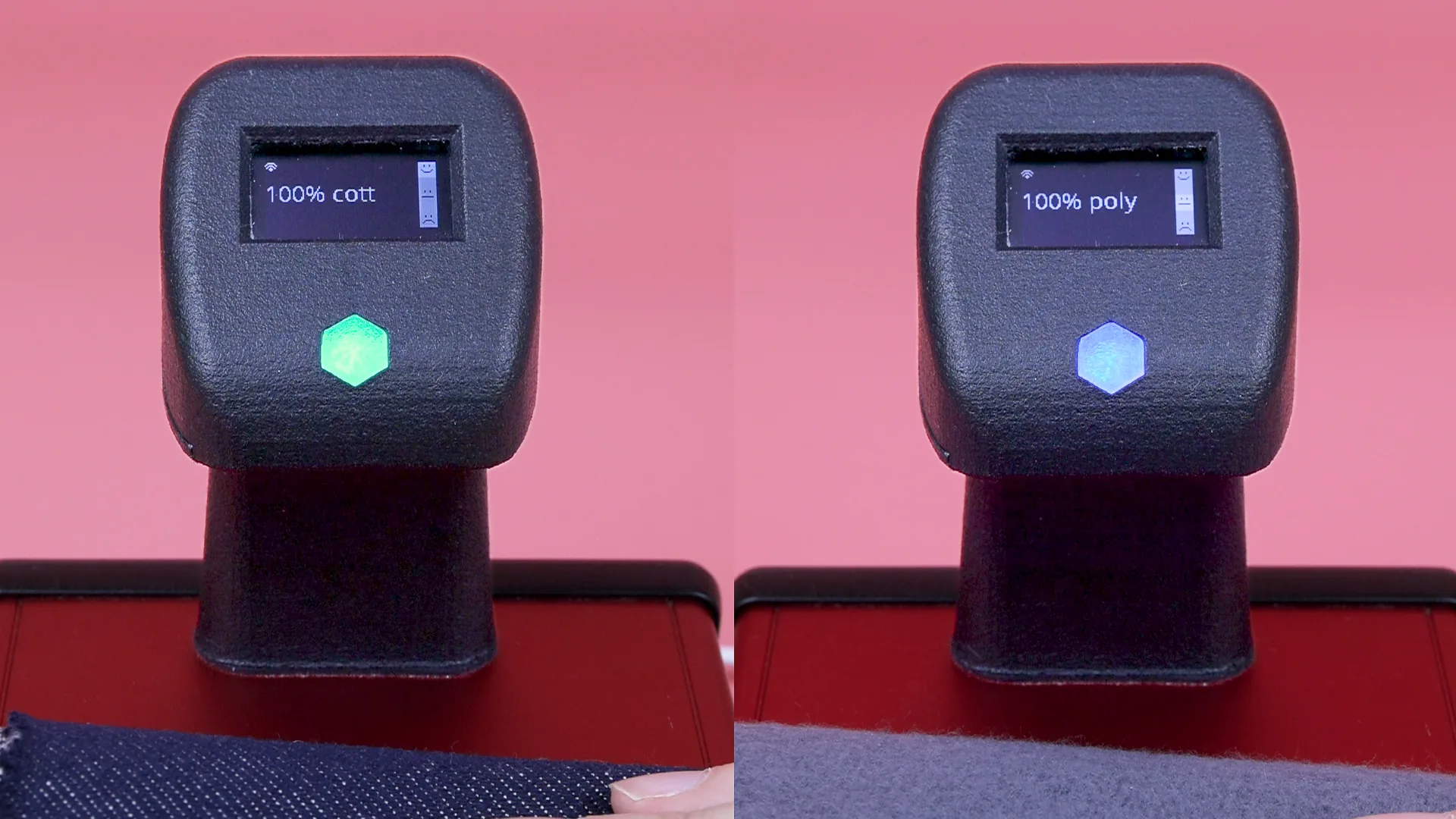
Instant LED result: sorters see the fibre type immediately, no guesswork, no second opinion needed.
The most common first observation, within weeks of introduction, is that some category of item was being systematically misidentified. Not the obvious ones. The ambiguous ones: blouses that might be silk or viscose, knits that could be fine merino or acrylic, denim that's 100% cotton or a cotton-polyester blend.
Visual sorting gets these right often enough that the errors don't feel systematic. But when you have an NIR device and you start scanning the items you'd have sorted by eye, you find a pattern. Some operators are consistently wrong on a specific fibre type. Some product categories are generating mis-sorts at a rate that the eye alone can't detect.
"We thought we had the silk problem under control. Turns out there was a whole category of viscose satin blouses we were sending to the wrong bin. It's not that the sorters were bad, it's just that the visual test isn't reliable on that product type."
— Operations Manager, UK second-hand retailer (composite account, details anonymised)
The second change: buyer conversations
Operations selling bales with composition claims report that the conversation with buyers changes when you can back the claim with scan records. The shift isn't immediate, buyers are used to receiving declarations without evidence. But when a dispute arises, having a cloud record of what the device identified on that batch creates a very different starting point.
Several operations report that the ability to share scan-level data proactively, as part of the delivery documentation, has become a differentiator with buyers who are doing their own QC on arrival. "They stopped testing every bale because they trusted the records" is a phrase we've heard more than once, though it's not universal.
The third change: training new staff
This one is less obvious but comes up consistently. NIR identification turns out to be a useful training tool for new sorters, not because the device replaces the human judgement that experienced sorters develop, but because it gives new operators immediate feedback on their calls.
Instead of a new sorter spending months developing a feel for ambiguous fibres and making wrong calls in the interim, they can check their visual identification against the device on uncertain items from day one. Operations report that this seems to accelerate the development of accurate visual identification, the device provides the calibration that experience alone takes months to build.
"New starters are useful much faster than before. They use the device on anything they're not sure about. After three or four months, they're scanning much less because they've learned what the device taught them."
— Sorting Floor Manager, textile recycler, Northern Europe (composite account, details anonymised)
What doesn't change
It's worth being honest about this. NIR identification doesn't change the fundamental pace of a sorting line if it's introduced as an additional step for every item. The operations that integrate it most successfully use it selectively, on ambiguous items, on high-value categories, or at specific checkpoints rather than on the full stream.
It also doesn't eliminate the need for experienced sorters. The device gives you a fibre identification. It doesn't assess condition, check for damage, or grade presentation for resale. The human judgement around those factors remains as important as before.
And it doesn't automatically improve buyer relationships, those require trust built over time, accurate records delivered consistently, and buyers who are willing to pay a premium for verified composition. That dynamic takes time to develop even when the data infrastructure is in place.
The honest summary
Operations that have integrated FabriTell into their sorting workflow, selectively, not universally, tend to report two durable benefits: fewer surprises on high-value fibre identification, and a better data foundation for buyer conversations. The magnitude of those benefits varies with the specific material stream and buyer relationships.
The operations that don't get value from it are usually those that introduce it as a mandatory scan on every item, create a bottleneck, and then abandon it because throughput suffers. The device works best as a decision-support tool on the items where the decision is hardest, not as a replacement for the judgement that's working fine already.
If you're considering it, the most useful thing you can do is talk to our team, we'll show you how FabriTell works on the kinds of items your sorters find ambiguous, walk you through the results, and talk through how it fits your operation.