The second-hand retail market has grown significantly, and with it the stakes around buying decisions. What was once a low-margin, low-stakes business, charity shops and car boot sales, now includes operations that pay meaningful prices for individual pieces and sell them at prices that assume they know exactly what they have.
In this environment, the cost of a wrong identification isn't just an embarrassing mislabel. It's margin erosion at volume. Price an item as cashmere when it's lambswool-acrylic and you've taken a loss on the buy-in. Price it as lambswool-acrylic when it's actually cashmere and you've left money behind. Do either of those at scale and the P&L reflects it.
Where the buying decision risk concentrates
The risk doesn't distribute evenly across the buying decision. Most items are easy, standard cotton jersey, obvious polyester, common wool knit. Experienced buyers make those calls correctly the vast majority of the time. The risk concentrates in a specific category: items where the visual and tactile cues are ambiguous, and where the price difference between getting it right and getting it wrong is significant.
That category tends to be:
- Fine knits that could be cashmere, fine merino, or a synthetic blend
- Lightweight drape fabrics that could be silk, viscose, or polyester satin
- Soft knits that could be angora blend, mohair, or high-quality acrylic
- Linen-look fabrics that could be linen, viscose linen blend, or polyester
- Denim and heavy cotton that might be 100% cotton or a stretch blend with elastane
This isn't a long list. But if these categories represent even 10–15% of volume, and the buying decisions on them have a meaningful error rate, the aggregate impact on margin is real, and probably untracked, because the error only becomes visible if you test the final product or get a customer complaint.
The economics of the NIR check
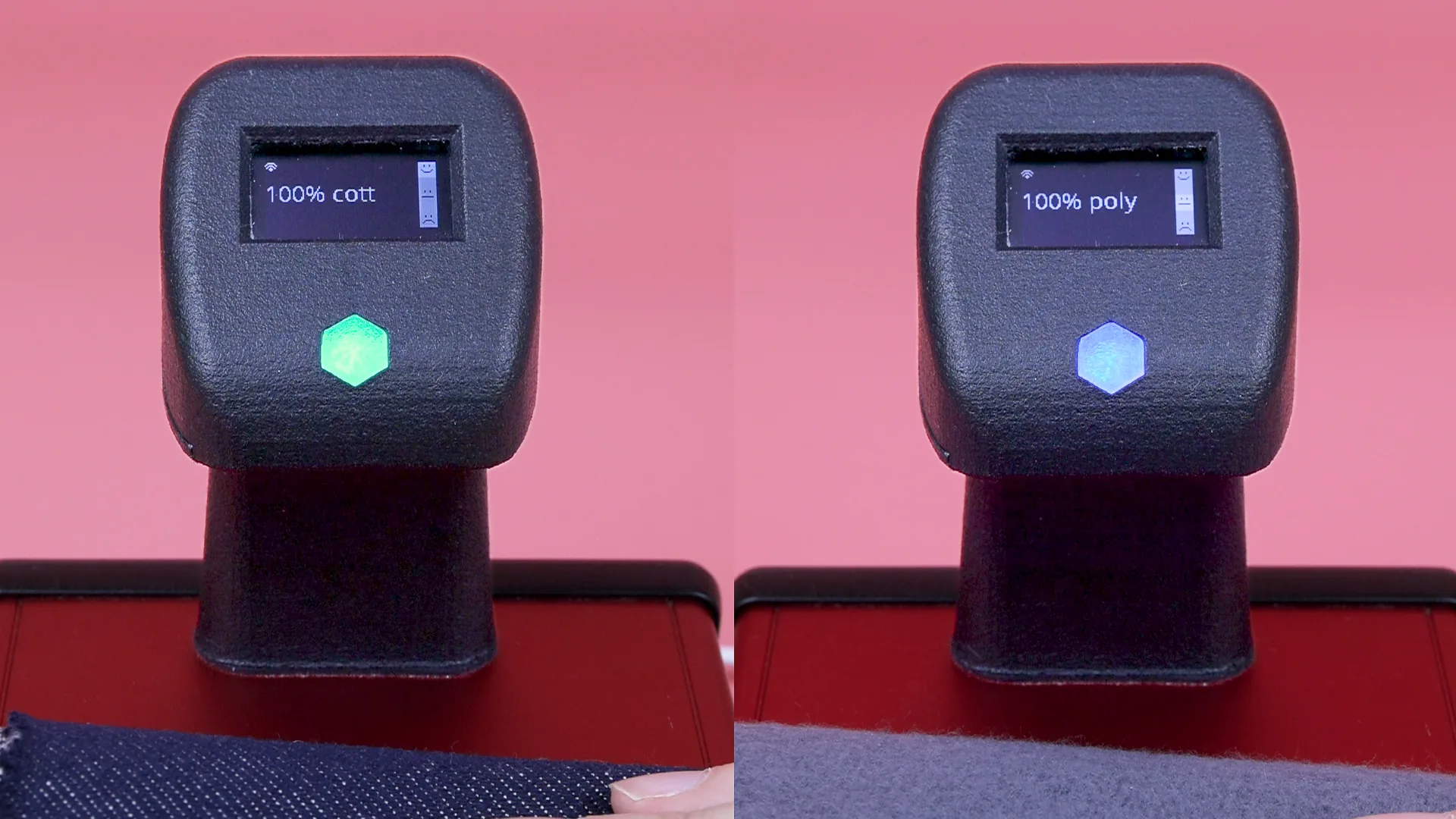
LED result in under a second: no label needed.
FabriTell reads the fibre itself.
The question isn't whether NIR identification is more accurate than experienced visual assessment on unambiguous items. On straightforward materials, experienced buyers are reliable, and a NIR check adds time without adding much. The question is whether NIR identification on the ambiguous category, the items where an experienced buyer would pause, pays for itself in margin capture.
The calculation is different for different operations. But consider a buying operation handling 1,000 items per week. If 10–15% of those are in the ambiguous category, and the price spread between "got it right" and "got it wrong" averages £5–10 per item on a mix of upside and downside, that's a meaningful number per week, at scale. NIR identification doesn't capture all of that, it can't solve condition issues or category decisions. But it removes the fibre identification uncertainty from the call.
The operations finding the most value from NIR in resale are those that use it selectively, as a check on the category that's actually ambiguous, not a mandatory step on every item. That keeps throughput viable while targeting the decisions where the tool changes the outcome.
Practical scenarios where NIR changes the decision
Cashmere vs. fine merino vs. lambswool-acrylic blend
All three can feel soft. All three can have similar handle in a fine knit. The label might be worn, faded, or absent entirely. A NIR check on an ambiguous soft knit gives a fibre identification that distinguishes protein fibres from synthetics, and in many cases distinguishes pure cashmere from merino or wool-acrylic blends. On an item where the price difference between categories is £20–40 on a single piece, that's a check worth making.
Silk blouse vs. viscose vs. polyester satin
Drape, sheen, and handle overlap significantly between these categories. Experienced buyers often use the burn test, but that's slow, requires a sample, and isn't reliable on all blends. A NIR scan takes one second and distinguishes silk (protein fibre) from viscose (cellulosic) from polyester (synthetic) with a reading rather than an inference.
Linen vs. linen-viscose blend vs. polyester linen-look
Linen-look polyester has improved significantly. Some versions are genuinely difficult to distinguish from real linen by eye and handle, particularly in mid-weight fabrics. NIR identification is definitive on this, the molecular composition of cellulosic natural fibre and polyester synthetic are distinct in the NIR spectrum regardless of how similar the visual properties are.
The grading and listing angle
Beyond the buying decision, NIR identification is becoming useful at the listing stage for operations that trade online or supply to curated resale platforms. Composition claims in listings are increasingly expected by platforms and buyers, and false claims create liability when buyers test on arrival.
Operations using FabriTell to verify composition before listing report that it removes the uncertainty from their descriptions on ambiguous pieces. Rather than "feels like cashmere, beautiful soft knit" (a phrase most buyers have learned to distrust), they can describe the identified composition with confidence. That's a small thing on any single listing. Across hundreds of listings, it affects buyer trust and return rates.
What second-hand operations typically find when they start scanning
The most consistent feedback from resale operations that introduce NIR identification is the same: the identification on the obvious items confirms what they already knew, and the surprises come in the ambiguous category. Some of those surprises are positive, items that were being underpriced because the buyer wasn't confident enough to claim the higher fibre category. Some are negative, items that were being overpriced based on a visual call that the device doesn't confirm.
Both types of surprise are useful. The positive ones improve margin. The negative ones prevent a reputation problem down the line. Operations that scan systematically over a few weeks also start to develop a picture of which categories in their buying source produce the most identification ambiguity, which informs how they buy, what they scrutinise, and how they price uncertainty.
FabriTell is designed for the pace of a sorting or buying floor, under-1-second identification, no sample prep, results on the device screen immediately. It identifies 10 pure fibre types and 13 blends including silk, wool, and fine synthetics.